Incredible journey: one wolf's migration across Europe
Slavc is a wolf. In 2011, he began an epic 2,000 kilometre migration
across Europe from Slovenia to Italy via the Austrian Alps. Several
months earlier, he had been fitted with a collar that allowed his
movements to be tracked in incredible detail. I talked to Hubert
Potočnik, the biologist whose work made this possible
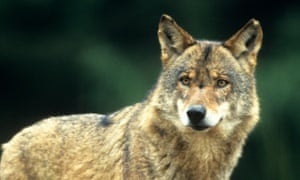
It has been estimated that there are now around 10,000 wolves in Europe. Photograph: tbkmedia.de/Alamy
Henry Nicholls
Every year, Hubert Potočnik and his colleagues at the University of
Ljubljana in Slovenia capture and collar a number of wolves in order to
get a handle on the movements of these much-misunderstood creatures. In
July 2011, he collared a young male that became known as Slavc. In June,
I spoke to Potočnik for a feature that appears in New Scientist
this week and he told me about Slavc’s extraordinary journey across
Europe. What follows is an edited transcript of the interview …
HN: After you captured and collared Slavc in July 2011, he
stayed with his pack for several months. Then, on 19 December 2011, he
began to move. How did you know?
HP: We knew something was different because the GPS points showed
that he had crossed two large motorways far outside of his natal
territory.
Tell me about these collars. How do they work?
The collar is equipped with three types of different technology. It
has a GPS receiver, a GSM modem to send SMS and also with a VHF radio
transmitter as a back-up. We programme all our wolves to send a GPS
signal every three hours, so we get about seven locations a day to give
us continuous location sampling data.
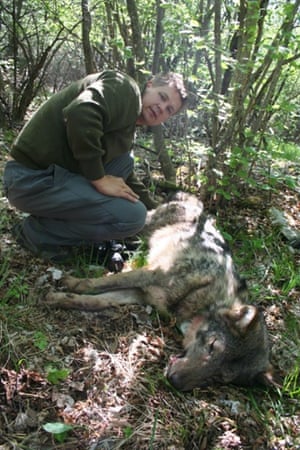
Hubert Potočnik fits Slavc with the collar in July 2011, a device that
will reveal the wolf’s incredible 2000-km migration from Slovenia to
Italy. Photograph: Nina Ražen
What if the wolf can’t get a signal? Do you lose a datapoint?
No, because the collar has a special memory storage. All locations
are stored and when the animal gets a signal again, it sends packages of
seven locations per SMS. Sometimes we didn’t get any data for 3, 4, 5
days. Then after that we got six or seven SMSs with about 40 locations
from the previous days.
The first motorway Slavc crossed was the A1 between Trieste and Ljubljana. How much of an obstacle would this have been?
It’s a fenced motorway. Wolves can only cross these highways on
underpasses or overpasses or along the rivers. He crossed the A1
motorway on an overpass.
What happened next?
The last location that we got on that first day was from the backyard
of a house in the middle of a small town called Vipava. Our first
thought was that he had been poached. While we were discussing what to
do with a wildlife manager from this region, discussing whether to call
the police and so on, we got another location which showed the wolf was
moving further and further.
He crossed another motorway, the H4?
It was quite easy. There is a 150 metre-long viaduct.
What time of day was he moving?
Typically he moved through these open areas during the night-time.
But not always. For example, he spent three days in the forest near
Ljubljana international airport and on the morning of the last day, he
passed through an open area and headed towards the Alps.
What else did you discover about his stay near the airport?
At every place he stayed for more than three hours, we went to
investigate and we found that he’d caught two foxes there. Our
colleagues from Austria
and Italy really got involved in this communication and sampling and
anlaysing what he was doing on the route, collecting spray and so on.
At that point, he wasn’t far from Ljubljana University. I don’t suppose you saw him did you?
No. Over the course of his entire migration, we had only one report
of a possible wolf sighting that might have been Slavc and that came
from Austria.
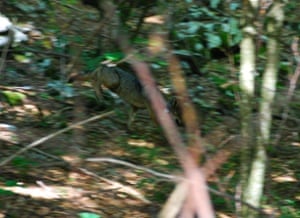
Look closely. Slavc heads off through the trees shortly after recovering
from his anaesthetic in 2011. Photograph: Hubert Potočnik
As Slavc passed through this very human landscape, how worried were you for his safety?
Along his route we were scared that someone would shoot this wolf,
thinking it was a stray dog because of its collar. We tried to
communicate through the media, local papers and inform especially
hunters about the wolf with the GPS collar.
Apart from the motorways, can you identify two other significant obstacles that Slavc faced over the course of his migration?
The Drava River was certainly a major obstacle. He actually crossed
it at a spot where the Drava is 280 metres wide. He swam. There is no
bridge and we got riverside locations on one side of the bank and on the
other. The only explanation is that he swam and crossed the Drava at
that very wide part.
He also made his way across some really high mountains, entering a
closed valley in the middle of winter where the lowest pass was 2,600
metres and the snow would have been about six metres deep. There were
really extreme conditions at the time.
Then he made his way into Italy?
When the wolf entered Italy I got an email from an Italian colleague about video footage of possible wolves in the Lessinia Natural Regional Park.
We started joking that Slavc was going there and would meet a female,
because from the footage it looked like a female because of the way it
urinated.
But he carried on past Lessinia?
Yes. He arrived in the Valpolicella region just north of Verona –
greenhouses and vineyards – in March 2012. That was the first time this
wolf killed a domestic animal on his route. He killed there, I think,
two sheep and a goat. He stayed there for 12 days, probably because
there was a private animal park and the owner had three captive wolves,
one female and two males. But then he moved back to the north, and
entered the Lessinia Natural Regional Park. It was April and we had
exact GPS locations and we asked a park manager to go and check the
tracks in the snow. When she got to the spot, she found the tracks of
two canids, the first indication that Slavc had actually met the female.
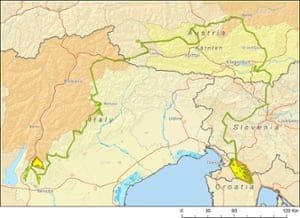
In zig-zagging his way from Slovenia to Italy, Slavc is estimated to
have travelled some 2000 km. Photograph: Hubert Potočnik, University of
Ljubljana
You had programmed Slavc’s collar to drop off in August 2012. Why?
We expected that the collar batteries would run out at around this
time. Besides getting some additional data stored in the collar, it is
ethical to release a collar from such an animal.
But Slavc is still in Lessinia with the female (who became known as Juliet)?
As far as we can tell. Slavc and Juliet had at least two cubs last
year because they were captured on camera traps set around their
territory and on this video it was possible to see two pups. The
information from this year is that they probably have another litter.
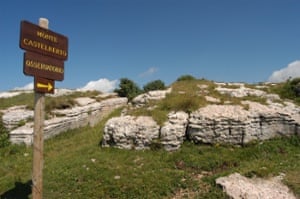
Lessinia Natural Regional Park just north of Verona. As far as we can tell, Slavc is still out there.
Photograph: La Casara Caseificio/flickrHow would you sum up this experience?
There are lots of data about long-distance dispersal of wolves but
there are very few cases where we have had the opportunity to follow an
animal in such detail. Following Slavc across Europe offered a rare insight into the secret life of the wolf. It was one of the most amazing events in my life.



No comments:
Post a Comment