Meet the wolves targeted in B.C.'s controversial kill
By Charles Mandel
January 22nd 2016
#4 of 4 articles from the Special Report:
State Of The Animal
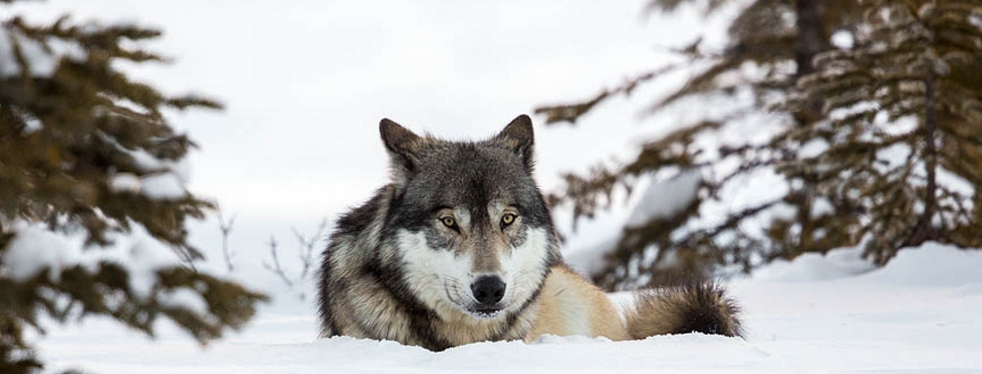
B.C. wild wolf. Photo courtesy of John E. Marriott
B.C.'s grey wolves are remarkable animals, able to cover a distance
of more than 100 kilometres in a single day with their pack. They rule
their territories — anywhere from 100 to 500 kilometres2 and
marked with scat and urine — as one of Canada's top predators. Now, some
are apparently being targeted to be shot from helicopters as part of a
controversial government effort to protect a dwindling caribou
population.
Gunning down wolves from helicopters is less likely to control the
wolf population of British Columbia than inflame public sentiment
against the government that condones the officially-sanctioned wolf
kills, according to Chris Darimont, the Hakai-Raincoast professor at the
University of Victoria and science director of Raincoast Conservation.
British Columbia’s controversial practice of using snipers in
helicopters to shoot grey wolves has drawn international attention. Pop
star Miley Cyrus
called the wolf cull a “war on wildlife,” and film actress Pamela
Anderson wrote B.C. Premier Christy Clark that “gunning down wolves is
not the answer.”
Photo of Miley Cyrus by April Bencze of Pacific Wild
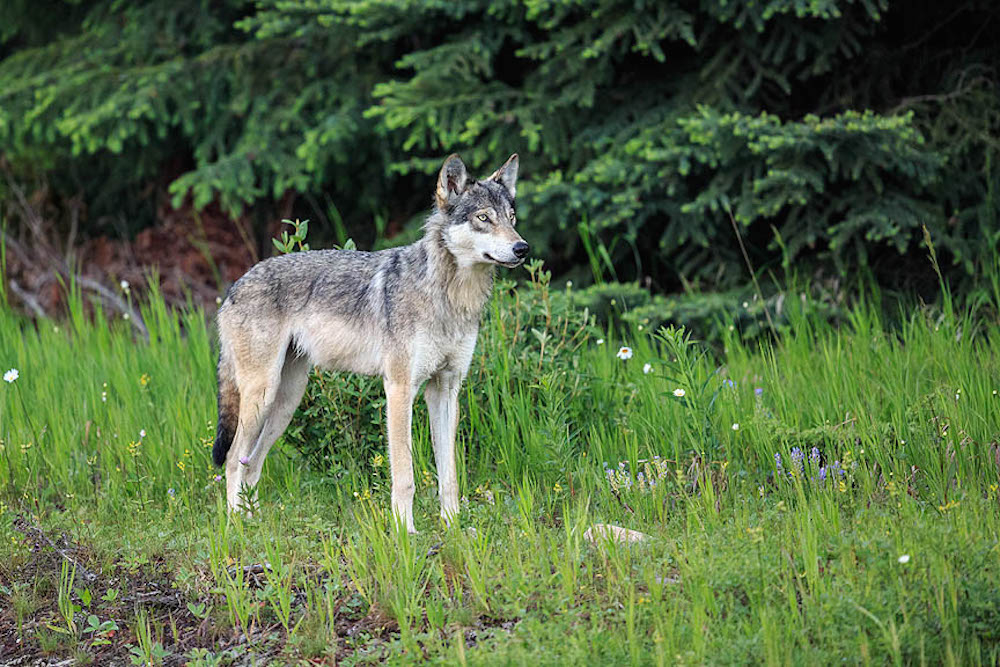
The 25 to 35-kilogram wolf hunts deer, elk, moose, caribou, bighorn
sheep and bison and will supplement its diet with smaller mammals,
including beaver, snowshoe hare and mice.
Grey wolves can scent prey from over 1.5 kilometres away and hunt as a
pack, running down faster animals such as deer and throwing their
weight against the prey to knock it off balance, according to the
Alberta Wilderness Association.
Even so, life in the wild is hard and wolves often die young, and
injuries sustained attempting to take down larger prey such as moose can
result in fatalities. The wilderness association says a pack’s hunting
success is low: on average, for every 12 moose pursued, only one is
killed.
To contact and locate pack members, wolves howl with each member
singing at a different pitch that is recognizable to the others. They
can hear howls from up to 10 kilometres away.
Darimont is adamant that wolf culling is not an effective strategy to help caribou recovery. "It’s a policy to influence politics. The province needs to be
recognized for 'doing something'. And despite the controversy about wolf
control now, its easier politically than halting industry where
endangered caribou roam."
But that strategy is likely to backfire on the province, Darimont
said, adding that predator control measures are often abandoned once
they come to light to an increasingly upset public. “The political calculus changes. It's getting towards that point in
B.C. Clearly, the environment is important to B.C. voters, and they no
longer want to give industry and government a free pass.”
At one time, grey wolves ranged across North America, but now are
restricted to wilder northern regions and national parks. They aren't
endangered, but habitat continues to shrink because of human activity.
To be sure, the question behind the wolf cull is how to protect the
endangered mountain caribou, an animal at risk of extinction. The
current mountain caribou population numbers about 1,500 in 15 separate
herds throughout the province. One herd, the South Selkirk, only has 18 surviving caribou. And in the South Peace, the four herds there are on the decline. The province contends the wolf is a key factor in the caribou
decline, attributing at least 37 per cent of all adult deaths to wolves.
But others argue that shrinking habitat from logging, other industry
and things like recreational snowmobiling are contributing most heavily
to the mountain caribou’s mortality — not the grey wolf.
The province maintains it has set aside some 2.2 million hectares of
protected habitat throughout the province, calling it caribou habitat
safe from industrial and recreational activity.
But with the continuing decline of the caribou, “the government made
the difficult decision and took the extraordinary action to remove
wolves in the South Selkirk and South Peace,” according to a government
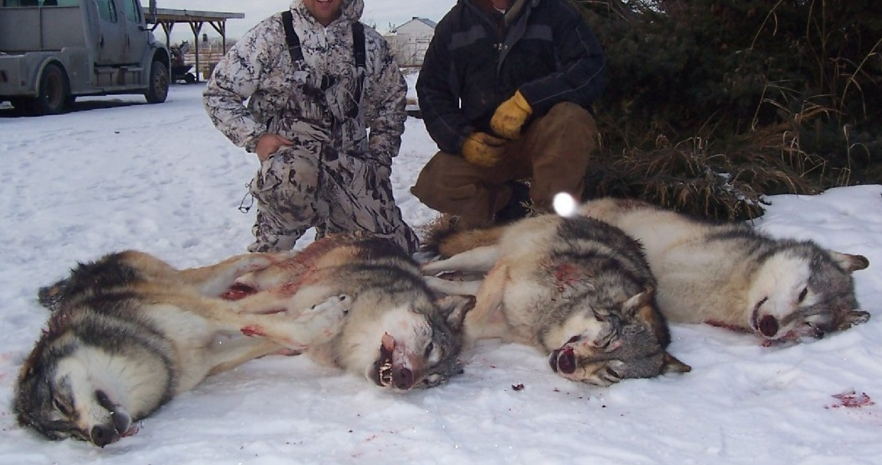
backgrounder. Hunters and dead wolves.
Not just an issue in B.C., Alberta culls wolves, too
Stan Boutin, a professor in the Biological Sciences Department at the
University of Alberta and the Alberta Biodiversity Conservation Chair,
says in Alberta logging and oil and gas exploration have forced wolves
and caribou into the same territory where once they were separate. In order to protect the caribou, Alberta began culling wolves in
2005. Boutin estimates the province has killed roughly 1,000 wolves to
date.
There, the wolves have been killed in one of two ways. Individual
wolves from different packs are captured by net-guns fired from
helicopters. They are then fitted with a VHF radio collar and released
so that they can lead the hunters to other pack members. After the pack members are killed, the radio-collared wolves are shot as well.
The second way has been to administer bait laced with strychnine distributed at 15 to 20 locations throughout the winters. But the poison has had collateral damage. In addition to some 154
wolves, the poison has also killed 91 ravens, 36 coyotes, 31 red foxes,
four American martens, three lynx, two weasels and two fishers,
according to a 2015 report, Maintaining Ethical Standards During
Conservation Crises, published in the peer-reviewed Canadian Wildlife Biology and Management.
Boutin says current information from the last assessment on a small
herd of caribou in west-central Alberta suggests the population has
stabilized with the wolf cull program; however, the number of caribou is
not increasing.
Boutin favours the cull and advocates that both habitat protection
and a cull “have to be in the toolbox.” He said it’s already too late to
try and bring in recovery strategies. He estimates it could take as
long as 50 years to properly restore habitat. “The magnitude of human development and action has been such that
even if we were to stop that development with protection, get really
aggressive with restoration and recovery, the time it takes to put that
back to the way it was when there was no overlap between wolves and
caribou is far too long.”
Halting industrial development in remaining habitat is important
In B. C., the Provincial Grey Wolf Management Plan, unveiled in April
2014, comes up for evaluation after four years. In the meantime, the
cull — and the killing — continues. Nonetheless, many wonder why the wolf should have to pay habitat lost to human activities.
In September 2015, 10 environmental groups sent a letter to Clark,
protesting the money being spent on the wolf cull while forests critical
to animal survival continued to be destroyed or fragmented by industry. The letter noted that habitat protection under the province’s 2007
Mountain Caribou Recover Plan was failing, while the funds went toward
predator control and caribou maternity penning and relocations.
The groups argued that if the province continued to expend resources
on “experimental techniques,” instead of concentrating on protecting
habitat, “B.C. could be left with no caribou, and if that happens, the
caribou conservation zones could revert to logging, with no new parks of
substantial size to help keep other species from extinction. “Meanwhile, potentially thousands of wolves might be brutally
slaughtered during the Province’s five-year wolf cull experiment, doing
severe damage to ecosystems.”
Darimont said that the truth is no one knows what will work for
caribou, at least in the short term, because so little has been done,
aside from wolf control. “Clearly, halting industrial development in remaining habitat and
restricting snowmobiles is important right now. If caribou remain over
longer time frames, restoring habitat is key.”
Darimont agrees that in terms of population, the wolves are not in
danger. He said they respond to persecution with increased reproduction
and movement to other areas. “And that's precisely why wolf control does not work. It's very
difficult to keep every wolf out of an area for long. And that's also
why its so cruelly unnecessary — many wolves die with no positive
benefit for caribou.”




No comments:
Post a Comment