
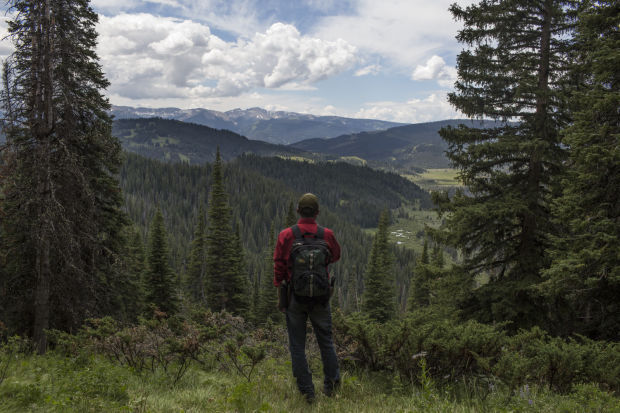
Ken
Mills, a wolf management specialist with the Wyoming Game and Fish
Department, looks west into the Gros Ventre Range outside Jackson after
collecting information at a wolf kill site on
11 Hours ago
11 Hours ago
GROS VENTRE RANGE – Fur piled in a
mess under a fallen tree. A jawbone lay nearby. The spine was farther
down the hill by some ribs. Part of a shoulder was 50 yards in another
direction. They were the first signs of a female moose killed
months before by a pack of wolves. Little remained of her body. But her
bones told a story.
Inch-long splinters were jammed next to her teeth, remnants of a life spent eating bushes and tree limbs. The bits of wood created abscesses that had rotted away portions of her jaw. She was sick, and that may have lowered her defenses, which is what matters to wolves, said Ken Mills, wolf biologist for the Wyoming Game and Fish Department. “They kill the vulnerable,” he said. Mills, 35, was gathering information in late July on how many moose, deer and elk wolves have killed in the Gros Ventre Range in northwestern Wyoming.
Wolves’ impact on big game numbers is a matter of debate. Some hunters pin a decline in moose numbers solely on wolves; others say elk herds are smaller and more scattered because of the predators. Wolf advocates say the effect is exaggerated.
Concrete data in Wyoming outside of Yellowstone National Park is only now being gathered, and varies greatly by region, said Arthur Middleton, a researcher with the Yale School of Forestry who has studied wolves extensively in Wyoming. And the data matters. If wolves are contributing to a decline in moose in a certain area, for example, managers could have considered increasing the number of wolf permits.
Now that research has been suspended. A recent federal court ruling placed the animal back on the endangered species list, transferring its management from the Wyoming Game and Fish Department to the U.S. Fish and Wildlife Service. While the future of wolf management works its way once more through the court system, biologists like Mills and Middleton say studies like Mills' will help people decide where wolves should live in the West. “There are just places we’re not going to have wolves again. New Jersey is historic wolf range; you’re not going to have them there,” Middleton said. “But you can have them in a lot more areas than they are. But if you’re going to do that, you’ve got to wait years and years until people get used to them, until they normalize as part of the landscape.”
*****
One of Mills’ first experiences with wolves involved pulling 4- to 6-week-old puppies out of their dens in Canada to implant radio transmitters inside their bellies. The transmitters didn’t harm them, but let researchers follow the pups through the first few years of life to track their survival rates.
Mills grew up in southwest Michigan. He started working with wolves as an undergraduate at Michigan Tech University, where he helped monitor the predators. After graduation, a professor showed him a job announcement for the Canadian position, and he applied. “I’ve always had a fascination with wildlife, and wolves were my opportunity,” he said.
He chose wolves, but in a way, wolf work also chose him, he said. One job led to another. From Canada, he moved to New Mexico to work on the controversial Mexican wolf program. Anti-wolf sentiment was so strong there, an FBI counterterrorism agent once became involved. “There were threats,” he said. “Things like, ‘When you get a new truck, you should get a bulletproof one.’”
Moving to Wyoming and its divisive wolf politics in 2008 seemed minor in comparison. Most of Wyoming’s vitriol had calmed since the predators were reintroduced in 1995. Still, the topic can inspire intense feelings, and part of Mills’ job was to bring the opposing sides together.
“If you’re going to work with wolves, you have to have the right personality. Everybody talked about Ed Bangs’ personality,” Mills said, referring to the retired U.S. Fish and Wildlife Service wolf recovery coordinator. “He would have a room full of people who hated each other, and at the end of the day they would be laughing. It’s not fun and games, but to go through everything with wolves you have to have a positive personality.”
Mills started working with newly delisted wolves in July 1, 2008, as part of Wyoming’s wolf management team. But on July 18, less than three weeks after Mills moved his wife and child to Pinedale, a federal judge put wolves back on the endangered species list. His work stopped, hands tied.
*****
When the Fish and Wildlife Service reintroduced gray wolves into Idaho and Wyoming, the listing order said the region needed 30 documented wolf breeding pairs in the region for three years in a row to be considered recovered.
Wyoming, Montana and Idaho hit those requirements by 2002. To continue a delisting, each state needed to provide the federal government with a plan to guarantee local leaders could monitor, manage and maintain viable wolf populations into the future. States began working on those in 2003, and what followed was a roller coaster of courtroom battles, judge's decisions, appeals, and endless meetings.
Wyoming’s plan allowed wolves to be shot on sight in 85 percent of the state, unlike Idaho and Montana, which established statewide hunting areas.
Conservation groups sued in 2008, and a judge placed wolves back on the list. Three years later, in April 2011, the Obama administration permanently delisted wolves in Idaho, Montana and parts of Oregon and Washington through a budget rider. The next year, the Fish and Wildlife Service approved a revamped Wyoming plan.
Mills, who had spent the previous four years investigating livestock kills and working on other animal species, once again went back to working on wolves. He spent summers tracking packs, determining reproduction rates and radio collaring wolves. In the winters, he monitored numbers.
“When wolves were delisted, I think the state really came together on it, and we had a lot of support from the public and the levels all the way through even the legislature to do what we were doing,” he said. “There were disagreements and people who would want to see different things, but for the most part I was really floored how people reacted.”
But the peace would not stay for long. Last year, a U.S. District judge placed them back on the list once again. Lawmakers proposed a bill in February to permanently delist wolves in Wyoming. It is working its way through a committee. If that doesn’t work, it could take two years for Wyoming to go through the delisting process again.
The problem for wolf management comes when the animals are viewed as either black or white, good or bad. Their future rests in the gray area, said Middleton, the Yale researcher. He likes to cite a quote from wolf scholar David Mech in presentations and papers. “The wolf is neither a saint nor a sinner except to those who want to make it so,” Mech once wrote.
People need to understand wolves’ real impact, Middleton said, and make decisions with those facts.
Mills agrees. But his participation in gathering data is now limited. His research tracking wolf kills is scrapped. He’d collared four wolves to help him find the kill sites, and those collars are no longer working. The U.S. Fish and Wildlife Service doesn’t have money to continue the project. If and when wolf management goes back to the state, he will need to start over.
“You want to start something and follow it through and come out with some data and information to help guide management,” he said. “But the stop and go nature of where wolves are makes that difficult. It is difficult to do your job when you’re back and forth, just like it’s difficult for the public to go back and forth as well.”
source
Inch-long splinters were jammed next to her teeth, remnants of a life spent eating bushes and tree limbs. The bits of wood created abscesses that had rotted away portions of her jaw. She was sick, and that may have lowered her defenses, which is what matters to wolves, said Ken Mills, wolf biologist for the Wyoming Game and Fish Department. “They kill the vulnerable,” he said. Mills, 35, was gathering information in late July on how many moose, deer and elk wolves have killed in the Gros Ventre Range in northwestern Wyoming.
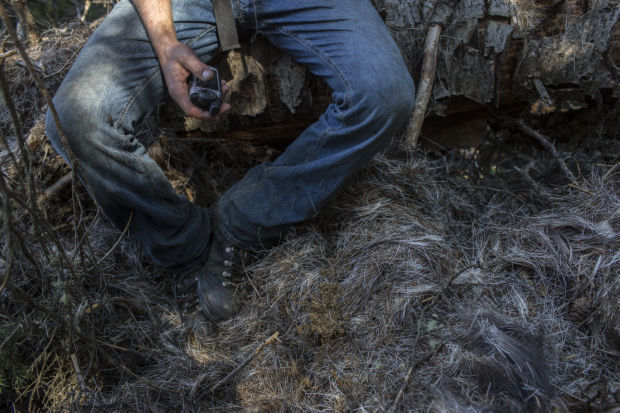
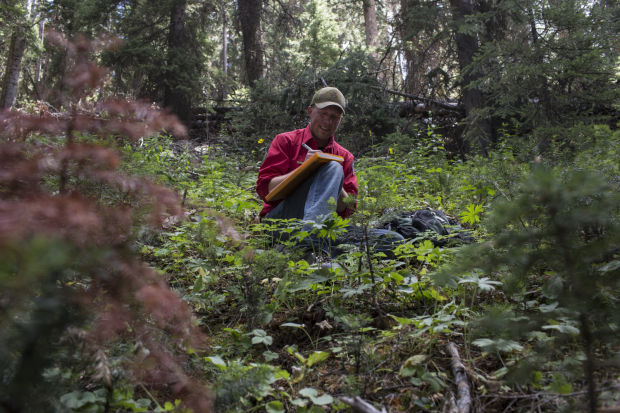
Seated
on a fallen tree beside a bed of moose hair, Wyoming Game and Fish
Department large carnivore biologist Ken Mills checks GPS coordinates
after finding a kill site on Thursday, July 31, 2014, deep in the Gros
Ventre Range outside Jackson. According to estimates based on GPS data
from collared wolves, the moose had likely been killed four months
earlier. Wolves had torn and spit out its hair while eating the animal's
hide, leaving just a bed of fur and bones behind. (Ryan Dorgan,
Star-Tribune)
Wolves’ impact on big game numbers is a matter of debate. Some hunters pin a decline in moose numbers solely on wolves; others say elk herds are smaller and more scattered because of the predators. Wolf advocates say the effect is exaggerated.
Concrete data in Wyoming outside of Yellowstone National Park is only now being gathered, and varies greatly by region, said Arthur Middleton, a researcher with the Yale School of Forestry who has studied wolves extensively in Wyoming. And the data matters. If wolves are contributing to a decline in moose in a certain area, for example, managers could have considered increasing the number of wolf permits.
Now that research has been suspended. A recent federal court ruling placed the animal back on the endangered species list, transferring its management from the Wyoming Game and Fish Department to the U.S. Fish and Wildlife Service. While the future of wolf management works its way once more through the court system, biologists like Mills and Middleton say studies like Mills' will help people decide where wolves should live in the West. “There are just places we’re not going to have wolves again. New Jersey is historic wolf range; you’re not going to have them there,” Middleton said. “But you can have them in a lot more areas than they are. But if you’re going to do that, you’ve got to wait years and years until people get used to them, until they normalize as part of the landscape.”
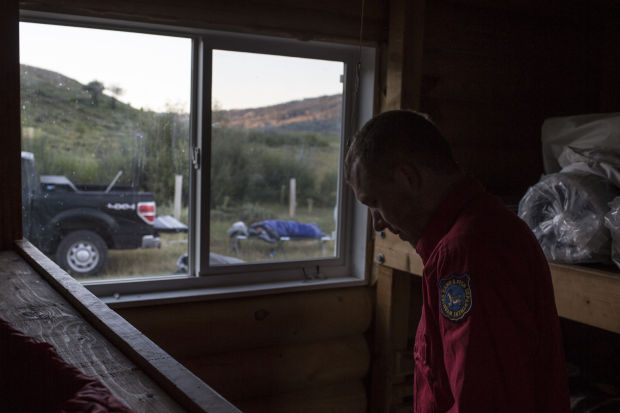
Ken
Mills begins his day with the sunrise on Thursday, July 31, 2014, from a
Wyoming Game and Fish Department patrol cabin in the Gros Ventre Range
outside Jackson. Preceding a September ruling that transferred Wyoming's
wolf management responsibilities to the U.S. Fish and Wildlife Service,
Mills' role as the department's wolf management specialist took him
deep into the backcountry to analyze wolf kills in order to determine
the impact of predation on moose, deer, and elk populations. (Ryan
Dorgan, Star-Tribune)
*****
One of Mills’ first experiences with wolves involved pulling 4- to 6-week-old puppies out of their dens in Canada to implant radio transmitters inside their bellies. The transmitters didn’t harm them, but let researchers follow the pups through the first few years of life to track their survival rates.
Mills grew up in southwest Michigan. He started working with wolves as an undergraduate at Michigan Tech University, where he helped monitor the predators. After graduation, a professor showed him a job announcement for the Canadian position, and he applied. “I’ve always had a fascination with wildlife, and wolves were my opportunity,” he said.
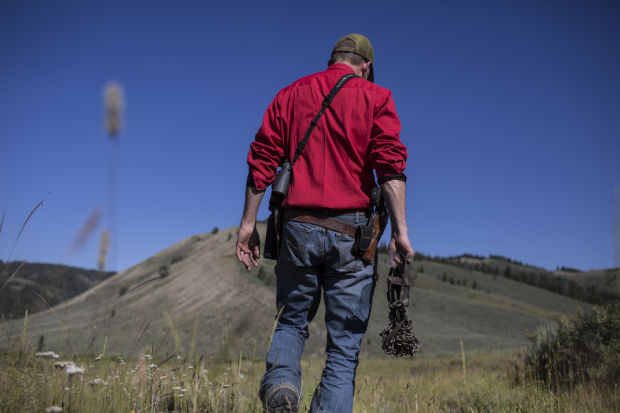
Ken
Mills removes a wolf trap that had been triggered on Thursday, July 31,
2014, in the Gros Ventre Range outside Jackson. Preceding a September
ruling that placed wolf management under responsibility of the U.S. Fish
and Wildlife Service, Mills' work with Wyoming Game and Fish Department
involved collaring wolves and tracking their whereabouts in order to
determine the species' true impact on moose, deer and elk populations
throughout the Gros Ventre. (Ryan Dorgan, Star-Tribune)
He chose wolves, but in a way, wolf work also chose him, he said. One job led to another. From Canada, he moved to New Mexico to work on the controversial Mexican wolf program. Anti-wolf sentiment was so strong there, an FBI counterterrorism agent once became involved. “There were threats,” he said. “Things like, ‘When you get a new truck, you should get a bulletproof one.’”
Moving to Wyoming and its divisive wolf politics in 2008 seemed minor in comparison. Most of Wyoming’s vitriol had calmed since the predators were reintroduced in 1995. Still, the topic can inspire intense feelings, and part of Mills’ job was to bring the opposing sides together.
“If you’re going to work with wolves, you have to have the right personality. Everybody talked about Ed Bangs’ personality,” Mills said, referring to the retired U.S. Fish and Wildlife Service wolf recovery coordinator. “He would have a room full of people who hated each other, and at the end of the day they would be laughing. It’s not fun and games, but to go through everything with wolves you have to have a positive personality.”
Mills started working with newly delisted wolves in July 1, 2008, as part of Wyoming’s wolf management team. But on July 18, less than three weeks after Mills moved his wife and child to Pinedale, a federal judge put wolves back on the endangered species list. His work stopped, hands tied.
*****
When the Fish and Wildlife Service reintroduced gray wolves into Idaho and Wyoming, the listing order said the region needed 30 documented wolf breeding pairs in the region for three years in a row to be considered recovered.
Wyoming, Montana and Idaho hit those requirements by 2002. To continue a delisting, each state needed to provide the federal government with a plan to guarantee local leaders could monitor, manage and maintain viable wolf populations into the future. States began working on those in 2003, and what followed was a roller coaster of courtroom battles, judge's decisions, appeals, and endless meetings.
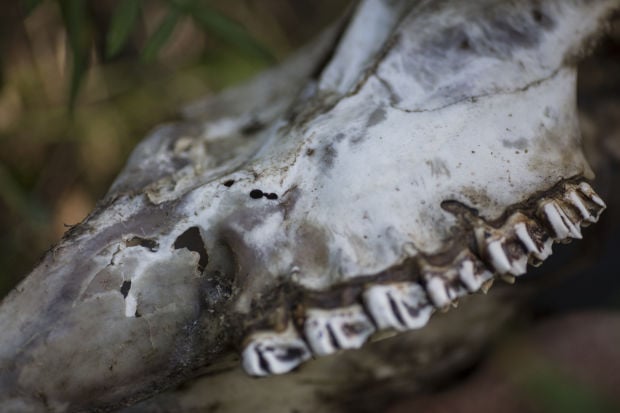
Punctures
and fractures from wolf bites line the snout of a cow moose skull found
on Thursday, July 31, 2014, deep in the Gros Ventre Range outside
Jackson. Signs of infection and decay on the moose's gums that led to
jaw necrosis are a sign that the moose was likely in poor health, making
it an easy target for wolves. (Ryan Dorgan, Star-Tribune)
Wyoming’s plan allowed wolves to be shot on sight in 85 percent of the state, unlike Idaho and Montana, which established statewide hunting areas.
Conservation groups sued in 2008, and a judge placed wolves back on the list. Three years later, in April 2011, the Obama administration permanently delisted wolves in Idaho, Montana and parts of Oregon and Washington through a budget rider. The next year, the Fish and Wildlife Service approved a revamped Wyoming plan.
Mills, who had spent the previous four years investigating livestock kills and working on other animal species, once again went back to working on wolves. He spent summers tracking packs, determining reproduction rates and radio collaring wolves. In the winters, he monitored numbers.
“When wolves were delisted, I think the state really came together on it, and we had a lot of support from the public and the levels all the way through even the legislature to do what we were doing,” he said. “There were disagreements and people who would want to see different things, but for the most part I was really floored how people reacted.”
Ken
Mills writes down his findings after tracking a wolf kill cluster that
yielded the remains of a cow moose on Thursday, July 31, 2014, in the
Gros Ventre Range outside Jackson. Preceding a September ruling that
placed wolf management under responsibility of the U.S. Fish and
Wildlife Service, Mills' work involved tracking wolf kills in order to
help the Wyoming Game and Fish Department better understand the impact
of predatory wolves on game species populations. (Ryan Dorgan,
Star-Tribune)
But the peace would not stay for long. Last year, a U.S. District judge placed them back on the list once again. Lawmakers proposed a bill in February to permanently delist wolves in Wyoming. It is working its way through a committee. If that doesn’t work, it could take two years for Wyoming to go through the delisting process again.
The problem for wolf management comes when the animals are viewed as either black or white, good or bad. Their future rests in the gray area, said Middleton, the Yale researcher. He likes to cite a quote from wolf scholar David Mech in presentations and papers. “The wolf is neither a saint nor a sinner except to those who want to make it so,” Mech once wrote.
People need to understand wolves’ real impact, Middleton said, and make decisions with those facts.
Mills agrees. But his participation in gathering data is now limited. His research tracking wolf kills is scrapped. He’d collared four wolves to help him find the kill sites, and those collars are no longer working. The U.S. Fish and Wildlife Service doesn’t have money to continue the project. If and when wolf management goes back to the state, he will need to start over.
“You want to start something and follow it through and come out with some data and information to help guide management,” he said. “But the stop and go nature of where wolves are makes that difficult. It is difficult to do your job when you’re back and forth, just like it’s difficult for the public to go back and forth as well.”
source
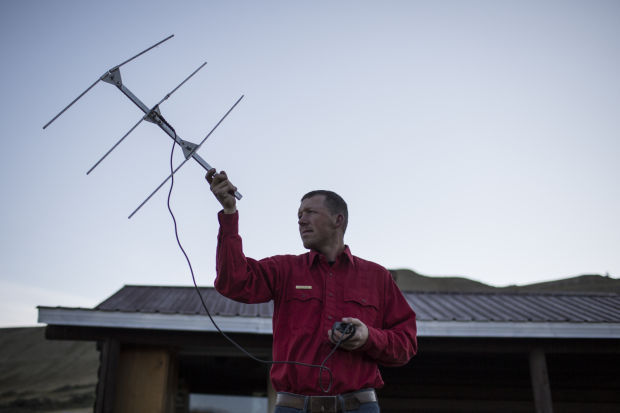
Ken
Mills, a wolf biologist with Wyoming Game and Fish Department, uses an
antenna to determine if any collared wolves are nearby on Thursday, July
31, 2014, in the Gros Ventre Range outside Jackson. Though now
suspended following a September decision placing wolf management in
federal hands, Mills' research focused on wolves' predation on moose,
deer and elk in order to determine their true impact on game species.
(Ryan Dorgan, Star-Tribune)
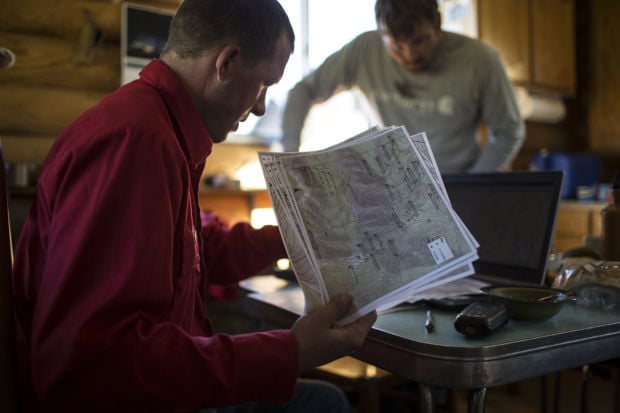
GPS
coordinates of collared wolves' locations are emailed to Ken Mills each
morning, giving him an idea of where to look for remains of their prey.
The longer a collared wolf stays in a single area, the higher a
likelihood the wolf and its pack had made a kill and stuck around to
feed and rest. (Ryan Dorgan, Star-Tribune)
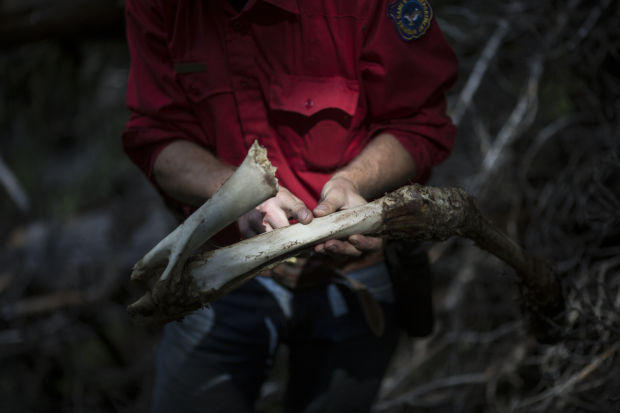
Ken
Mills holds a cleaned cow moose leg found while tracking wolf kills on
Thursday, July 31, 2014, in the Gros Ventre Range outside Jackson. A
nearby skull showed signs of infection and decay on the moose's gums
that led to jaw necrosis - a sign that the moose was likely in poor
health, making it an easy target for wolves. "It's not that wolves kill
the sick and the old and the young, they kill the vulnerable," said
Mills, a wolf management specialist with Wyoming Game and Fish
Department. "Vulnerability matters to a wolf. It's not just 'kill
everything,' it's opportunity and vulnerability." (Ryan Dorgan,
Star-Tribune)
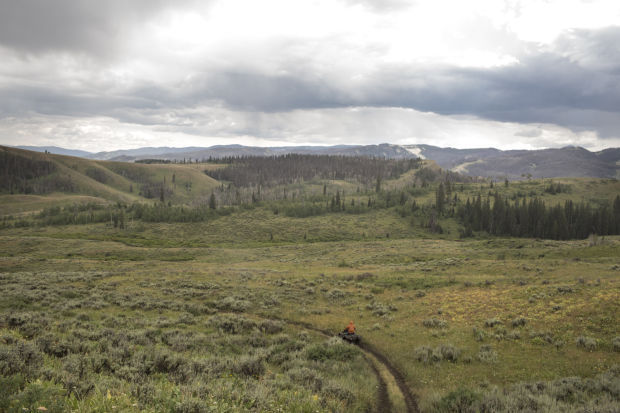
After
a day of tracking wolf kills, Wyoming Game and Fish Department large
carnivore biologist Ken Mills rides some two hours on an ATV back to the
department's patrol cabin on Thursday, July 31, 2014, in the Gros
Ventre Range outside Jackson. Preceding a September ruling that
transferred Wyoming's wolf management responsibilities to the U.S. Fish
and Wildlife Service, Mills' role as the department's wolf management
specialist took him deep into the backcountry to analyze wolf kills in
order to determine the impact of predation on moose, deer, and elk
populations. (Ryan Dorgan, Star-Tribune)


No comments:
Post a Comment