Saturday, May 7, 2016

Wolf numbers down, panel wants grizzlies off list

Phil Drake, 

HELENA — Members of the Environmental Quality Council were updated Thursday on the number of gray wolves in Montana, five years to the day that the animals were delisted from federal protections for being an endangered species.

And members later agreed to send a letter to federal officials that broadened the scope from an earlier proposal to delist grizzly bears in the Yellowstone ecosystems area to the entire state.

There are an estimated 536 wolves in Montana in 2015, down 18 from the year before and 32 breeding pairs, down from two, said Ken McDonald, Fish, Wildlife and Parks division administrator.

According to a 2015 annual management report from Montana Fish, Wildlife and Parks, in northwest Montana officials verified 349 wolves in 85 packs. In western Montana, 78 wolves were verified in 22 packs, four of which were breeding pairs and in southwest Montana there were 109 wolves in 19 packs verified, eight of which were breeding pairs.

Wolves were delisted in 2011, when state management took full effect through Montana Fish, Wildlife and Parks using a combination of federal funds and sportsman dollars.

According to the report, the U.S. Department of Wildlife Services reported 64 livestock losses in 2015 due to wolves compared to 47 in 2014. During 2015, the Montana Livestock Loss Board paid $79,312 for livestock killed by wolves.

The reported noted 51 wolves were killed to reduce further losses, the lowest number killed due to depredation in 10 years. Of those 51, 35 were killed by Wildlife Services and 16 were killed by private citizens.

McDonald said the number of wolf complaints has decreased steadily from 233 in 2009 to 91 in 2015.

Nick Gevock, conservation director of the Montana Wildlife Federation, said the state and federal departments involved in the wolf program deserve praise.

“It’s a healthy number of wolves geographically,” he said. “I think this proves the state can do it.”
In other numbers, wolf license sales generated $455,000 for wolf management in 2014 and $417,000 in 2015.

In 2014, Montana held its fifth wolf season; 206 wolves were taken: 60 percent by hunters, 40 percent by trappers. In 2015, 210 wolves were taken; 65 percent by hunters, 35 percent by trappers, state officials said.

The EQC then reviewed a proposal to remove the Greater Yellowstone ecosystem population of grizzly bears from the federal list of endangered and threatened wildlife.

The federal government, in its report, stated the population has recovered and no longer meets the federal guidelines of a threatened species. The ecosystem includes five national forests including Yellowstone and Grand Teton national parks.

Mike Hagener, the Montana Fish, Wildlife and Parks director, said this was for a “recovered” group of bears and the state should be proud about its grizzly bear numbers. He said they have grown from about 200 in the 1970s to 700 bears now.

The federal government was taking comment on the proposal until May 10.

Chelcie Cargill of the Montana Farm Bureau said her organization supported statewide delisting, noting that grizzly bears caused $111,126 in livestock losses to a confirmed 84 animals in 2015 and $55,151 in losses to 32 animals in 2014.

Sen. John Brenden, R-Scobey, said he asked that two letters be sent to the federal government. One of the letters should state that the EQC supports delisting the bears in Yellowstone and the other letter says it supports delisting grizzly bears in the entire state.

After some debate, in which Brenden resisted suggestions to turn his motion into two separate proposals, the measure passed 11-5.


More online
To read the gray wolf management report, go to: http://1.usa.gov/24ADA8J
To read about delisting of grizzly bears, go to: http://1.usa.gov/1rYBSjP

 source


Wolf pups from St. Louis get new mother, new home in New Mexico


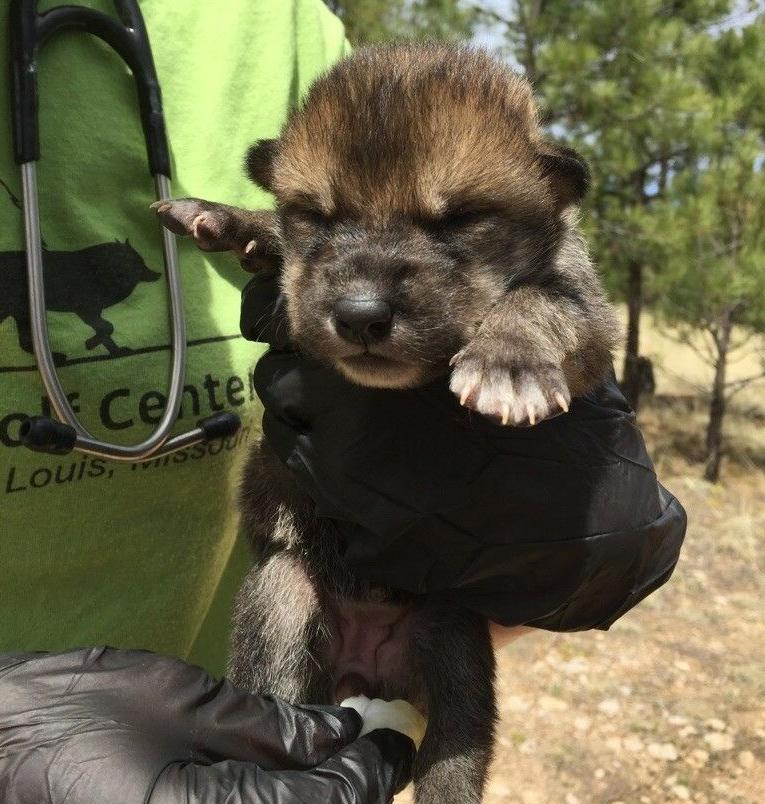
With 9-day-old pups tucked securely in a special backpack, Regina Mossotti hiked into the mountains in New Mexico to say goodbye to the newborns who were about to make history — and possibly a difference in the survival of their critically endangered species.

The Mexican wolves, born April 15 at the Endangered Wolf Center in Eureka, had flown with Mossotti and another helper more than 1,000 miles for their mission. The wolves, named Vida and Lindbergh, represent hope for a species with fewer than 100 individuals left in the wild.

The mission: Take the pups from their biological mother and siblings from their home in captivity in Eureka and “cross-foster” them with a surrogate mother in the wild who had given birth around the same time.

Cross-fostering can help the Mexican wolves survive by increasing the genetic diversity of the wild population. The 9-day-old Mexican wolf pups were moved from the more genetically diverse captive population and will contribute to the gene diversity of the wild population if they survive to become breeding adults.

But for it to work, there was a lot that had to line up. Placing captive-born pups into wild dens had never been tried before with Mexican wolves.

First, there was the timing. The wild and captive litters need to be born around the same time, and the transfer of pups from captivity to the wild has to occur before the pups are 10 days old, experts say. This makes the transfer easier for the pups, who still have their eyes closed and, much like other newborns, spend most of their time sleeping and eating. Then, there were the logistics. The wild den location needs to be known, a flight needs to be scheduled and weather conditions should be perfect.

The Endangered Wolf Center worked with the U.S. Fish and Wildlife Service on the effort. In New Mexico, a female wolf that was tracked with a GPS collar had stopped roaming like wolves do most of the time, and was staying in one location and then disappeared — a good indicator that she had gone down into the den and the satellite signal was no longer working. This was a clue to the Fish and Wildlife Service that she had given birth.

Mossotti and Emma Miller, an animal keeper at the center in Eureka, flew commercially to New Mexico with Vida and Lindbergh. They drove a few hours to Catron County and hiked about a mile and a half, where they met Fish and Wildlife staff to hand over the pups. The staff then hiked about another mile and half to the den to place the pups. During the trip, they fed the puppies formula.
But would their surrogate mother wolf accept them?

Placing the pups

When staff got close to the den, the mother wolf ran away. That she left her litter shows how scared of humans wolves are, said Mossotti. The mother stayed close, though, about 100 meters away, while the staff went to work.

In the den, they found five puppies. The goal was to help disguise the new puppies as the mom’s own as quickly as possible. The puppies’ escorts wore gloves the entire time they were handled to avoid transmitting unfamiliar scents. They rubbed dirt on Lindbergh and Vida, and rubbed them with their new siblings, as well as their urine, to transfer scents.

And then the staff left.

Within the hour, Lindbergh’s and Vida’s surrogate mother returned to her den. And she has stayed in the area since.

At this point, conservationists consider it a successful cross-fostering.

“Wolves are very nurturing,” Mossotti said. “They have this instinct to take care of these puppies. Fish and Wildlife Service did a great job of making sure those pups blend in with her litter.”

Wildlife staff are supplementing the pack’s natural diet by giving them elk that have been hit by cars. That supplemental food will help the foster parents take care of their new, larger litter of seven.

Once declared extinct in the wild

This could be a key point in saving the Mexican wolf, which had been hunted to the point where they were declared extinct in the wild in 1980.

The first release of Mexican wolves back in the wild took place in March 1998, with nine of the 11 wolves released coming from the Endangered Wolf Center.

The past releases were of adult wolves. While those born in captivity do well, those raised and taught to survive in the wild by a mother and father who already have a pack established have much better chances, Mossotti said.

A spokesman for the U.S. Fish and Wildlife Service in New Mexico called Lindbergh’s and Vida’s placement in the wild historic.

The service began using cross-fostering with other species as a management tool in 2014 in an effort to increase the gene diversity of the wild population.

Mossotti said getting the pups from a den in St. Louis to a den in New Mexico successfully was nothing short of exhilarating — and exhausting.

As for Lindbergh’s and Vida’s biological mom, she has taken the adoption of two of her babies well.
“She handled it great. She went back and cared for the (remaining) pups she had. She didn’t look stressed. She looked calm,” Mossotti said. “We know it’s such a vital need for the species to survive. It’s not an easy thing to do, but it’s so important.”

Lindbergh’s and Vida’s biological siblings soon will be available for viewing on the Endangered Wolf Center’s live web cam at www.endangeredwolfcenter.org/webcams.


Wolf Weekly Wrap-Up by @Defenders of Wildlife


A Congressional attack on Mexican gray wolf recovery
Mexican gray wolf, © Jim Clark/USFWS 
As you may remember, last week the U.S. Fish and Wildlife Service agreed to complete a full recovery plan for the Mexican gray wolf, or lobo, by November 2017. Congress wasted no time in attacking such an important step in Mexican gray wolf recovery. Last Friday, Senators Jeff Flake (R-Ariz) and John McCain (R-Ariz) introduced “The Mexican Gray Wolf Recovery Plan Act of 2016.” Don’t let the name fool you. While our experts are still analyzing the bill, it’s already safe to say that this is an egregious attack on Mexican gray wolf recovery that puts the states first, the Service second and the lobos last. The lobos are facing dwindling numbers, smaller litters and lower pup survival – a recipe for extinction. Defenders will be taking action next week when Congress is back in session. Keep an eye out for an email from us asking you to take action on this bill soon!

Mexican gray wolf pup, © USFWS

New lobos in the New Mexico
 
Last week, two Mexican gray wolf pups were introduced into the New Mexican wild. These wolves were the result of cross-fostering, an experimental technique where pups born in captivity are placed into the dens of wild wolf mothers. Although cross-fostering is intended to move genes from the captive to the wild population, which the lobos need so desperately as they face an intense genetic diversity crisis, it is very difficult to pull off. A wild den with pups must be found, the captive and wild litters must be born within five days of one another and the captive pups must be moved within about ten days of birth. Given these logistical hurdles, scientists caution that cross-fostering is unlikely to address the problem of species recovery. As our Southwest Director Bryan Bird said in this article, “Unfortunately, the cross-fostering is not going to be enough to save the wolves in the wild. [The Service] needs to introduce adult wolves.”

 source


Friday, May 6, 2016

Studies confirm effect of wolves, elk on tree recovery in Yellowstone National Park

05/05/2016
 
CORVALLIS, Ore. – An analysis of 24 studies over a 15-year period has confirmed that wolves and their influence on elk represent a major reason for the recovery of trees that had previously been declining for decades in Yellowstone National Park.

Despite long-term trends of increased temperatures and reduced precipitation, trees such as cottonwood, willow, aspen and other woody species have been showing signs of accelerated growth in many areas since wolves were restored to the park in 1995. Beavers and riparian songbirds are also showing signs of coming back to areas where they had been missing or in decline since the 1930s. 

Still, it will likely take many years for established shrubs and trees to reach a size sufficient to produce the abundance of berries and seeds that support a diverse ecosystem.

Those are among the conclusions reported today in the journal Biological Conservation by Robert Beschta and William Ripple, two professors in the Oregon State University College of Forestry. They analyzed the results of 24 studies of streamside vegetation published since 2001 and reviewed long-term trends in temperature, precipitation, snowpack and stream discharge.

“When I first started studying this in 2001,” said Beschta, “I was skeptical that elk, a native ungulate, could stop nearly all cottonwood recruitment. But it was the elk that had damaged plant communities during the period when wolves were absent, and the reductions in elk browsing, since wolves have returned, are allowing them to begin recovering.”

In subsequent studies, Beschta and Ripple, as well as other researchers, measured the diameter of cottonwoods and aspen in the park’s northern range.  They found young trees almost completely missing.

“For decades, nothing had been growing into the smaller age classes of trees because of intensive elk browsing,” Beschta said. 

In their latest assessment, Beschta and Ripple reviewed 11 published studies of willow, six of aspen and five of cottonwood as well as one each of service berry and thinleaf alder. All but two of the studies showed increases in height, diameter, canopy cover or recruitment for these species. The area of land covered by willow, for example, doubled between 1991 and 2006. By 2003, young aspen trees in many areas were starting to grow measurably higher.

More than half of the reviewed studies also measured browsing effects on plants, caused principally by elk. Those studies concluded that tree recovery had begun mostly because of a decrease in browsing.

“Climate may influence whether trees recover more quickly in some areas than in others to some degree, but the real issue for plants growing in Yellowstone is, how often are they browsed by ungulates?” Beschta added.

Elk numbers in Yellowstone have declined by more than two-thirds since 1995, from a high of nearly 20,000 to less than 5,000 today. The numbers and impacts of deer and pronghorn are relatively small, but in the past decade, bison herds have grown, and they tend to reside in valley bottoms much of the year. Bison grazing has prevented cottonwoods, willow and other plants from successfully recovering in parts of the Lamar Valley, he said. 

Over the past 20 years, mean temperatures and precipitation in the northern range have changed in comparison to the long-term mean going back to 1895, when recordkeeping began. As measured at the Mammoth weather station in Yellowstone, annual mean temperatures today are more than 2 degrees Fahrenheit warmer than in 1895 and annual precipitation almost 3 inches lower.      
  
“Research results following wolf reintroduction are generally supportive of the concept that the contemporary carnivore guild has, via a trophic cascade, mediated the effects of elk herbivory on riparian plant communities,” the authors wrote. “The ongoing reduction in elk herbivory has thus been helping to recover and sustain these plant communities in northern Yellowstone, thereby improving important food-web and habitat support for numerous terrestrial and aquatic organisms.”

About the OSU College of Forestry: For a century, the College of Forestry has been a world class center of teaching, learning and research. It offers graduate and undergraduate degree programs in sustaining ecosystems, managing forests and manufacturing wood products; conducts basic and applied research on the nature and use of forests; and operates 14,000 acres of college forests.


Thursday, May 5, 2016

“This wolf has kind of brought this neighborhood together,” Wild ‘wolf’ living in Choctaw


Posted May 2, 2016
CHOCTAW, Okla. - A so called wild 'wolf' is claiming a Choctaw neighborhood as her home.
Some people have been referring to her by the name Spirit.

The Choctaw animal control officer believes she is a hybrid, a dog with some wolf in her.
Last summer, NewsChannel 4 told you she was living in the Choctaw Creek neighborhood.

Residents there worried when she disappeared, but they can find comfort now knowing she has found a new home not too far away.

The wolfdog has captured the eyes and hearts of her new neighborhood.

"One night, stopped out here, and next thing I know there's like three or four different families all out here having some beers and stuff, and everybody's sitting there watching the wolf," said Tim Jenne. "This wolf has kind of brought this neighborhood together.”

Wild in nature, it is nearly impossible to get close to her.

Animal Control Officer Kenneth Grant said, after more than five years, he has given up his fight to catch the K-9.

"Every time I go out, she sees my truck ,and she's gone," Grant said. "She knows who I am."
She is a smart creature that is slowly warming up to Jenne and his dogs.

"At work, everybody calls me the wolf whisperer,” Jenne laughed.

He said he first saw her three months ago.

"She just started hanging by the house in the woods there," Jenne pointed out.

Each day, she got a little closer and eventually made friends with his dogs, and now amazingly enough she is eating out of the palms of his hands.

She is even stepping foot in his house.

"She's been gentle. She's awesome," Jenne said.

A once lone wolf seems to have found her pack.

Jenne said Spirit is part of the family now and hopes she will eventually stay in his backyard.

source


Biologists Introduce "Foster" Wolf Pups to New Mexico Pack

Public News Service - NM | May 2016 
Two pups born to Mexican gray wolves at the Endangered Wolf Center in Missouri were recently introduced into a wild den in New Mexico. (Endangered Wolf Center)

Two pups born to Mexican gray wolves at the Endangered Wolf Center in Missouri were recently introduced into a wild den in New Mexico. (Endangered Wolf Center)
May 3, 2016
ALBUQUERQUE, N.M. - U.S. Fish and Wildlife Service biologists have released a pair of Mexican gray wolf pups born in a wildlife preserve into an existing den in New Mexico, but the state isn't happy about it.

New Mexico game officials had warned the federal agency to not introduce new wolves into the state and is threatening to sue.

Regina Mossotti, director of animal care and conservation with the Missouri-based Endangered Wolf Center, assisted with the operation and says a lot of things had to go just right to successfully accomplish the cross-fostering.

"And it's just a really tough thing to do, in the fact that all the stars have to align," she says. "The pups have to be born within a few days of each other. You have to be able to know where the wild den is, you have to be able to get to the wild den, you have to be able to get transportation. The weather has to cooperate. This year it was neat, because everything really lined up."

Mossotti says once a den was found, she flew with the pups from near St. Louis, Mo., to New Mexico, traveled overland for hours and hiked more than a mile to get them to the den near the Arizona border.

The New Mexico Game and Fish Department claims the state's wildlife management laws take precedence, but federal officials forged ahead.

Now state officials say they're studying their legal options.

Mossotti says it may be mid-summer before biologists can confirm whether the pups were adopted. She adds all Mexican wolves in the wild can trace their roots to the Endangered Wolf Center, and says it is critical to add new blood to the wolf packs.

"Mexican wolves are critically endangered," Mossotti says. "They're one of the most endangered wolves in the world, and so when you are dealing with a population that's that small, genetic diversity is always an important factor in recovering an endangered species."

She says this cross-fostering exchange was the first time that captive Mexican wolf pups have been introduced into a wild litter. The last count showed only 97 of the endangered Mexican wolves living in the wild, and Mossotti says introducing new pups is vital to their long-term survival.

Mark Richardson, Public News Service - NM
source 

2 US senators want states included in wolf management


Posted: Tuesday, May 3, 2016 
ALBUQUERQUE — Two U.S. senators from the West want state wildlife authorities and ranchers to have more say in how the federal government manages endangered Mexican gray wolves. Arizona Republicans John McCain and Jeff Flake have introduced legislation that would push the U.S. Fish and Wildlife Service to work more closely with states to revamp a decadesold recovery plan for the wolves.
If the agency fails, the legislation includes language that would allow states to step in.

“This is an important issue to Arizona,” Flake said in a statement. “The U.S. Fish and Wildlife Service needs to consider the effect the Mexican gray wolf population has on the people of Arizona and our economy when revising the outdated recovery plan.”

Flake and McCain argue that tens of millions of dollars have been spent on reintroducing wolves in Arizona and New Mexico over nearly two decades and the population is still struggling.

The legislation comes as federal wildlife managers consider expanding the wolf’s range and as landowners and some local elected leaders in the West push back against what they describe as overreach by the federal government and the trampling of private property and water rights.
The fate of the legislation is uncertain but some opponents are concerned the proposal could end up as an amendment and slipped into an unrelated appropriations bill.

There was a similar fight over the delisting of northern gray wolves in Wyoming and other states last year.

Environmentalists argue the legislation is a political ploy rather than an effort to move the wolf recovery program forward.

Drew Caputo, the vice president of litigation for the environmental group Earthjustice, suggested the failure of the Fish and Wildlife Service to revamp the wolf recovery plan over the past three decades stems from federal officials catering to states and the states bowing to a narrow band of ranching and hunting interests.

“They’re not following the science and the law and instead are buckling under to the state politics,” Caputo said. “I think there’s a growing recognition that these sort of political-based bills are bad policy and they’re not passing.”

The Fish and Wildlife Service recently agreed as part of a legal settlement with environmentalists to have a recovery plan crafted by the end of 2017.

Fish and Wildlife Service spokesman John Bradley said the agency appreciates the senators’ interest in the wolf and that the goal remains the recovery of the species through growing the population, improving genetics and eventually transferring management back to the states.

Bradley said the proposed legislation is under review.

New Mexico wildlife officials said the legislation appears to be something that the state could support. Just last month, the state Game and Fish Department announced its intent to sue the federal agency over plans to release more wolves into the wild. The state contends the Endangered Species Act requires cooperation with states when working to recover threatened and endangered species.

source

Environmental group says lawmakers misrepresented bill to delist wolves

PAMPLIN MEDIA GROUP FILE PHOTO - An environmental group claims Oregon lawmakers misrepresented provisions of a bill adopted by the Legislature that removed wolves from the endangered species list.
The environmental group Cascadia Wildlands is accusing three Oregon lawmakers of knowingly misrepresenting a bill that ratified the state’s decision to remove gray wolves from the endangered species list.

The complaint was filed Monday with the Oregon Government Ethics Commission against Rep. Brad Witt, D-Clatskanie; Rep. Sal Esquivel, R-Medford; and Rep. Greg Barreto, R-Cove.
Barreto introduced House Bill 4040 during the short legislative session earlier this year. The Oregon Department of Fish and Wildlife had previously determined wolves no longer need endangered species protections, and the Fish and Wildlife Commission followed through with delisting wolves in November 2015.

HB 4040 effectively gave the Legislature’s stamp of approval, and Gov. Kate Brown signed off on the bill in March. Cascadia Wildlands argues that in order to secure votes for the bill Witt, Esquivel and Barreto made false statements that HB 4040 would not affect a judicial review of the wolf delisting decision. 

“There’s a real concern this bill passed through the House with a fundamental misunderstanding of what it does,” said Nick Cady, legal director for Cascadia Wildlands. “Salem can be somewhat of a black box ... We perceived this as pretty egregious.”

Cascadia Wildlands, Oregon Wild and the Center for Biological Diversity had all requested a judicial review of the delisting decision. The case was tossed by the Oregon Court of Appeals on April 22, which cited HB 4040.

Cady claims the bill’s sole purpose was to block their review, despite claims from Barreto, Witt and Esquivel. According to the complaint, Barreto said during a Feb. 4 hearing that the bill “does nothing more than shore up the decision by the Fish and Wildlife Commission,” and “Our objective in this is not to usurp the authority of the commission. It is only to shore up the decision that they have made and to make the (wolf) plan a workable plan as was written.” He also sent a written document to colleagues stating the bill had no language precluding judicial review.

However, on Feb. 16, the Legislative Counsel Committee issued a report to Sen. Michael Dembrow, D-Portland, stating that the only legal effect of HB 4040 was to “validate any real or perceived irregularities” in ODFW’s decision under state law.

“In essence, the only effect of the bill was to preclude judicial review of the commission’s delisting decision,” the complaint reads.

HB 4040 passed the House 33-23, and the Senate 17-11.

Since then, ODFW shot and killed four wolves from the Imnaha Pack in northeast Oregon for frequently attacking livestock in the area. There is still no legal hunting of wolves allowed in Oregon.
Barreto said he had not seen the complaint as of Monday morning, but reiterated the intent of the bill was to affirm what ODFW had already done. “All we did was say yes, we agree with Fish and Wildlife,” Barreto said. “If that precludes their lawsuit, then so be it.”

Esquivel also said that he had not received a copy of the complaint, but was not worried about it because he did nothing wrong. “We didn’t intentionally try to mislead anyone,” Esquivel said. “It’s our opinion, and our opinion’s our opinion.”

Environmentalists had asked for a review of the delisting decision because they argued it was not made with sound science, and had not been independently reviewed, as required by state law.

Cady said they are pushing to have the case reconsidered by the Court of Appeals. “To be very clear, the (wolf) recovery is going very successfully,” he said. “Our frustration is more just the pushback this species’ recovery is getting from state legislators and various lobbying interests.”

Oregon’s wolf population had grown to at least 110 animals by the end of 2015, a 36 percent increase over the previous year.

George Plaven is a reporter with the East Oregonian newspaper. Capital Bureau reporter Hillary Borrud contributed to this report.

 source
 

Group Seeks to Halt US Exports of Fur From Bobcats, Wolves


Fur ExportsThe Associated Press
FILE - In this Dec. 7, 2007 file photo a bobcat trapped in a snare at the Billings, Mont., airport looks out of his crate before he is released east of Shepherd, Mont. An environmental group is asking a federal judge to halt a United States government program that allows the export of tens of thousands of bobcat pelts and a small number of gray wolf pelts for sale on the international fur market. (Casey Riffe /The Billings Gazette via AP, File)

Wildlife advocates on Wednesday said they will seek a court order halting a United States government program that allows tens of thousands of pelts from bobcats and a small number of gray wolves to be exported annually for sale on the international fur market.
Representatives of WildEarth Guardians said the little-known program should not continue without a detailed study of its effect on wildlife populations.
Government figures show more than 57,000 bobcat pelts and a handful of wolf pelts were exported from the U.S. in 2014, the most recent year for which data was available. Exports over the past decade ranged from a low of 30,000 bobcat pelts in 2009 to almost 68,000 in 2013.
The pelts typically are used to make fur garments and accessories. Russia, China, Canada and Greece are top destinations, according to a trapping industry representative and government reports.
"The government's been allowing this to happen blindly without doing any analysis. When we're talking about such high numbers, it's just preposterous," said Bethany Cotton, director of WildEarth Guardians' wildlife program.
The group filed a lawsuit in federal court in Missoula challenging the U.S. Fish and Wildlife Service program. The agency regulates trade in animal and plant parts according to the Convention on International Trade in Endangered Species (CITES), which the U.S. ratified in 1975.
Bobcats are not considered an endangered species, nor are wolves in much of the Northern Rockies including Montana and Idaho. Nevertheless, the international trade in bobcat and wolf pelts is regulated because they are "look-alikes" for other wildlife population that are listed as endangered.
State wildlife agencies have opposed the inclusion of bobcats in the CITES treaty, arguing the species is thriving and protections are unnecessary. The animals are about twice as large as house cats and feed primarily on rabbits and hares. They range across the contiguous U.S. and portions of Canada and Mexico, according to the Association of Fish and Wildlife Agencies.
Between 2.3 million and 3.6 million bobcats lived in the U.S., with populations that were stable or increasing in at least 40 states, according to a 2010 study from researchers at Cornell University and the University of Montana.
Cotton said her organization became aware of the scale of bobcat fur exports when it sued state game officials in Montana over the accidental capture of another wild cat, Canada lynx, by trappers pursuing bobcats.
Fish and Wildlife Service spokeswoman Laury Parramore said the agency would not comment on pending litigation. But she said the government requires exported pelts to be legally acquired and "not detrimental to the survival of the species."
National Trappers Association President Chris McAllister says the targeting of exports marks a new tactic in a long-running campaign by advocacy groups to shut down the industry. Prior lawsuits have focused on the types of traps used and the inadvertent trapping of protected species.
"They're trying to use anything they can," McAllister said. "'If they can shut us down from exporting furs, it would definitely have an impact."
McAllister could not immediately provide figures on how many bobcats are trapped across the U.S. annually. He said prices for pelts from the animals fell drastically over the past several years, from as much as $1,000 for a top-quality pelt to just $200 today.


source

Group Says Efforts to Save Mexican Wolf Fall Short

grview-51658-1
TUCSON, Ariz. – It has been 40 years since the Mexican gray wolf was listed as an endangered species, but conservationists are concerned about what they see as a serious lack of progress in reintroducing the animal into the wild. In 2015, the U.S. Fish and Wildlife Service counted only 97 lobos in the wild in Arizona and New Mexico.

Fewer than 25 exist in Mexico, making it the most endangered animal in the world.
Eva Sargent, senior southwest representative with Defenders of Wildlife said the wolves need more genetic diversity to survive.

“All the Mexican wolves alive in the world today are the descendants of just seven wolves that started the captive breeding program,” she said. “When you have that sort of genetic bottleneck, you really need to work hard to preserve the genetic diversity you have, and unfortunately, that has never happened.”

She said Fish and Wildlife officials, who manage the current reintroduction program, have failed to release enough wolves from captivity to sustain and grow the population.
“And now we’re to the point where we can see the genetic repercussions of them losing some of that genetic heritage,” she added. “They are having smaller litters and they’re having lower pup survival, and that’s just a recipe for extinction.”

While the wild wolves are waiting for reinforcement, Sargent said there is good news in the form of a settlement this week between a coalition of conservationists and the Fish and Wildlife Service. The agreement requires the federal agency to produce a “legally sufficient” recovery plan for the wolves by November 2017.

“You know, we are racing extinction on the Mexican gray wolf,” Sargent stressed. “The best available science, not political pressure, should lead the recovery planning for lobos. We need more wolves and less politics.”

The settlement is the result of a 2014 lawsuit by an individual and four conservation groups, including Defenders of Wildlife, to force the Fish and Wildlife Service to comply with the requirements of the Endangered Species Act.

source