Don Jenkins
Capital Press

Washington Dept. of Fish and Wildlife
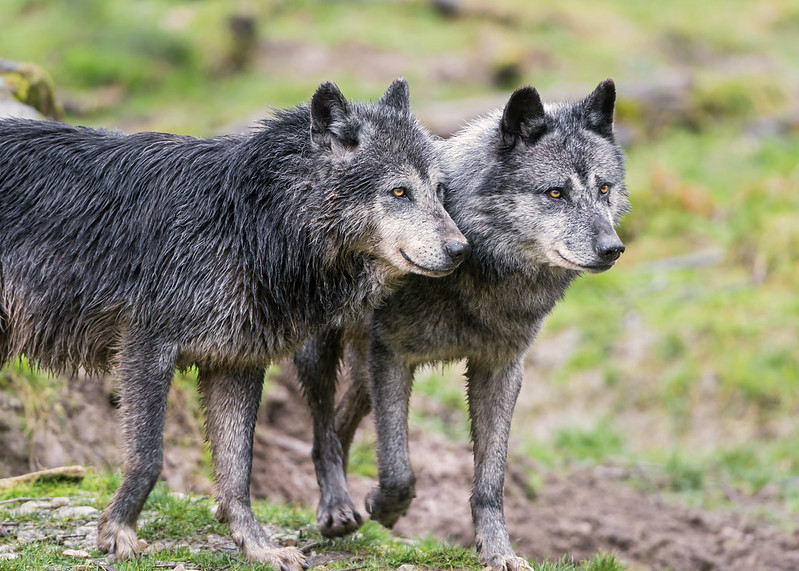
Two wolves from the Wenatchee wolf pack are seen in Pitcher Canyon with
the carcass of an elk. An ear tag can be seen in the right ear of the
wolf in the foreground.
Environmentalists hail the return of
gray wolves, but ranchers say the apex predators — and the state's high
goals — threaten their way of life.
Washington’s wolf population, concentrated in the northeast corner,
has reached critical mass, a milestone in a state where recovery
standards are high and so are passions.
Washington has fewer
wolves than Oregon and far fewer than Idaho, Montana and Wyoming. But
Washington Department of Fish and Wildlife biologists say the population
is poised to follow the same upward trajectory that other states saw.
But
more wolves may mean more conflicts with the state’s $700
million-a-year cattle and sheep industries. While vocal
environmentalists downplay the economic risks and hail the return of the
gray wolf, ranchers — some whose families have worked the land since
the 1800s — say the reintroduction of an apex predator threatens their
way of life.
At the center of the controversy is the state’s Wolf
Conservation and Management Plan. Conservation groups and livestock
producers continue to spar over the plan, which guides wildlife managers
and lays out recovery goals.
Adopted in 2011, Washington’s plan
sets a higher bar for success than the objectives established for Idaho,
Wyoming, Montana or Oregon. Until the goals are achieved, wolves will
be a protected species throughout the state, no matter how many occupy
northeast Washington.
House Agriculture and Natural Resources
Committee Chairman Brian Blake represents the state’s southwest corner,
far removed from wolf country. He agrees with those who say the plan
calls for too many wolves over too large a territory.
The Aberdeen
Democrat said a small percentage of Washingtonians are sacrificing for
wolf recovery, and the current plan doesn’t provide relief. “The original wolf plan was flawed,” Blake said. “It was a recipe for failure, and a failure is what we’re seeing.”
No progress documented
Federal recovery goals for the Rocky Mountain region were met seven
years after wolves were released in central Idaho and Yellowstone
National Park in 1995. In Oregon, state recovery goals were achieved
last year, six years after the first wolf pack was documented in 2008.
Washington’s
first wolf pack was discovered in 2008, too. It has nearly as many
wolves as Oregon, but under the state’s wolf plan recovery is at least
several years away and as much as a decade away, wildlife officials say.
WDFW estimates wolves will be eligible to be taken off the state’s
protected species list by 2021 — plus or minus three years. On paper,
there’s been no progress in meeting recovery goals in three years.
The
key difference between Washington’s wolf plan and the plans other
states used is the minimum number of breeding pairs needed before
wildlife managers can consider management measures, including hunting,
to control how many wolves live in the state, and where.
A
17-member work group that developed Washington’s plan decided the state
should have at least 15 breeding pairs, a number considered too low by
two of three scientists who conducted a peer review. Nevertheless, it
was more breeding pairs than required in other states.
The U.S.
Fish and Wildlife Service in the 1980s declared that Idaho, Montana and
Wyoming each needed at least 10 breeding pairs before gray wolves would
be eligible to be taken off the list of endangered species. But in
neighboring Oregon, only four breeding pairs are required for recovery
under that state’s plan.
Washington has counted five breeding
pairs each year since 2011. During that time, the wolf population has
almost doubled, from 35 to 68, and the number of packs has more than
doubled, from 7 to 16. “What does that tell you?” asked Washington
Cattlemen’s Association Executive Vice President Jack Field. To him, it
says counting breeding pairs is the wrong measurement. “It’s got to be packs,” he said. “It’s simple and attainable.” WDFW defines packs as two or more wolves traveling together in the winter.
However,
the definition doesn’t address whether wolves are successfully
establishing a family unit, said Tim Coleman, executive director of the
pro-wolf Kettle Range Conservation Group. “Two animals is not really a
pack,” he said.
When the wolf plan was written, dissenters in the
work group, including Field, said 15 breeding pairs — 50 percent more
than in states with fewer people and more wolf habitat — “defies common
sense.” Washington has more than 7 million residents, while Oregon has
3.9 million and Idaho 1.6 million. The dissenters proposed eight
breeding pairs.
To count as a breeding pair, a male and female
must have at least two pups surviving to the end of the year. But that
definition may be too narrow, critics say. In 2014, a Lookout pack male
and female raised one pup in north-central Washington, an area ravaged
by the largest wildfire in state history. A female in the Smackout pack
raised four pups after a cougar killed her mate. In both cases, the pups
didn’t count toward the recovery goals.
WDFW wolf policy lead
Dave Ware said there may be more breeding pairs than the five found last
year by biologists. “That’s what we were able to document. It doesn’t
mean that’s what’s on the ground,” he said.
Veteran wolf manager
Carter Niemeyer, who oversaw Idaho’s wolf recovery before retiring in
2006 from the U.S. Fish and Wildlife Service, said he believes the state
can support the number of breeding pairs called for in the wolf plan.
“Fifteen breeding pairs doesn’t seem unrealistic to me,” he said.
Besides
breeding pairs, Washington’s plan judges success by the number of
wolves reproducing in each of three zones. Each zone must have at least
four breeding pairs for at least three consecutive years.
There are four pairs in Eastern Washington, one in the North Cascades and none in the South Cascades. Ware said wolves likely are more widely distributed than the count shows.
More wolf sightings
Although the agency has not documented any wolves in the South
Cascades, wolf sightings there are constant and credible, he said. A
recent WDFW wolf presentation included a photo of a wolf in a field in
Klickitat County in south-central Washington.
Wolves may even be
crossing the Cascade Range. A wolf was seen in late April standing on
Interstate 90 in eastern King County. By the time state wildlife
managers arrived, the 2-year-old female had been hit and killed by a
truck. She was the first known wild gray wolf west of the Cascades in
decades.
Grant County rancher Bill Sieverkropp, president of the
state cattlemen’s association, said he hasn’t seen any wolves in his
section of Central Washington, but there’s talk. “You always hear rumors,” he said. “I imagine when the population grows, eventually we will see some come through our area.”
Klickitat
County rancher Neil Kayser says he’s skeptical wolves have ventured
down to where he is in south-central Washington, not far from the
Columbia River and Oregon, which lies south of it. His cousin and fellow
rancher, Keith Kreps, says he hasn’t seen any signs either and isn’t
worried about lone wolves passing through. But he says he’s heard of
reliable sightings and thinks wolves will come and packs will form. “We
are going to have them eventually. You can almost guarantee it’s going
to happen,” he said. “We think the cat (cougar) problem is bad. This
will be bad.”
Blake, the state legislator, said he believes wolves have made their way to the timbered wilderness of the South Cascades. “We
know there are wolves down there,” he said. “That is dense, difficult
ground for biologists to operate in to quantify wolves, and that’s going
to be a huge hurdle.”
In the North Cascades, Niemeyer took up
residence in a tent in mid-May to help Washington State University
graduate students find wolves to collar in Okanogan County. By late May,
they were still looking, without luck. “I guess I’m skeptical wolves will spread in Washington like prairie fire. I really don’t buy that,” he said.
Idaho
counted 14 wolves before the Canadian imports were released 20 years
ago. The count rose steadily and peaked at 856 in 2009, the first year a
state-sponsored wolf hunt was allowed.
Niemeyer cautions against
assuming Washington will see the same unrelenting growth as Idaho did.
Too many factors, such as the deaths of breeding females, could delay
recovery, he said.
Still, Niemeyer said wolves will disperse.
“There’s no doubt. It’s just a slow, gradual process. They will get
there. Wolves are tough, resilient and prolific,” he said.
A WDFW
consultant, Francine Madden, recently interviewed more than 90 ranchers,
environmentalists, biologists, legislators and others interested in
Washington’s wolves and found, unsurprisingly, strong feelings.
She also noted that her interview subjects were aware that most Washingtonians were “only mildly interested” in wolf recovery.
The deeply involved minority has presented the mildly interested majority with two competing narratives.
One
narrative says reintroducing a wily apex predator has burdened
northeast Washington residents. Wolves are entrenched in the region, and
livestock losses are mounting. Yet, statewide recovery is long into the
future. Therefore, wolves should be delisted in Eastern Washington and
managed accordingly.
The other narrative asserts that wolves and
ranchers can co-exist and that recovery is on track. Wolves are about to
break out and blossom into a statewide and sustainable population.
Don’t change a good plan that’s working.
Balancing act
The Legislature may yet produce a bill this year that seeks to balance those views.
House
Bill 2107 would require WDFW to reconsider the wolf plan, but the
legislation does not mandate any changes. WDFW would review several
issues, including whether poaching penalties are high enough and under
what circumstances the agency will kill wolves to protect livestock.
Washington
wolves made up less than 4 percent of the 1,802 gray wolves counted in
five Western states last year but accounted for almost 10 percent of the
312 sheep and cattle confirmed killed by wolves, according to the U.S.
Fish and Wildlife Service.
Washington wolves took at least two
cows and 28 sheep, according to WDFW, though Stevens County rancher Dave
Dashiell estimates he actually lost more than 300 animals to the
Huckleberry pack.
A state lawmaker from northeast Washington, Rep.
Joel Kretz, has more than once told his colleagues in Olympia that
“social tolerance” for wolves is about gone in his district.
Northeast
Washington ranchers and county commissioners this year delivered the
same message in intense testimony at the Capitol in Olympia. “We can’t afford to wait for the whole state to recover because there won’t be any of us left,” Dashiell told legislators.
Kretz
has proposed relocating wolves to unoccupied areas to hasten statewide
recovery, an option included in the state’s wolf plan. The option,
though, looks highly unlikely. No legislator has volunteered to have his
district host wolves. So wolves must spread naturally and at their own pace.
Field,
of the cattlemen’s association, said he believes recovery will come
before WDFW’s projected date of 2021. “I’m going to put my money on the
under,” he said. The bet is based on expectations that wolves will
multiply rapidly. It’s also based on the idea that WDFW may change how
it measures recovery from breeding pairs to packs.
Field said he
thinks recovery will occur before 2021 even if WDFW sticks with breeding
pairs. “I’m going to be naively optimistic and say ‘Yes,’” he said.
Coleman,
one of the environmentalists on WDFW’s wolf advisory group, agrees.
“More than likely, yes, it will come earlier,” he said. “I think it will
happen because the habitat is there.”
In the meantime, the U.S.
Fish and Wildlife Service calls the wolf comeback in the West an
“amazing success.” It’s considering taking gray wolves off the
endangered species list entirely, including Central and Western
Washington.
Blake said Washington errs by not considering the
federal success good enough. The state’s wolves should be seen as the
western edge of a thriving Rocky Mountain population, he said. “Personally, I believe wolves are biologically recovered in Washington state today,” he said.
source